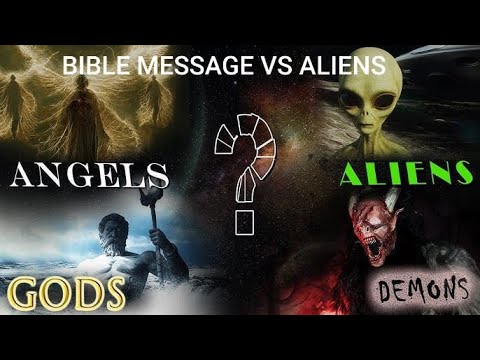
Title: Bible Versus Aliens: A Conversation Between Faith and Science Fiction
The question of whether we are alone in the universe is one that has fascinated humanity for centuries. As scientific advancements bring us closer to understanding the cosmos, this age-old question intersects with religious beliefs, particularly those derived from the Bible. The potential existence of extraterrestrial life raises intriguing discussions on faith, creation, and humanity’s place in the universe.
Biblical Perspectives on Creation
The Bible, particularly in the book of Genesis, outlines a creation narrative in which God forms the earth, the heavens, and all living creatures. The text emphasizes humanity’s unique role, stating that humans are made in the image of God (Genesis 1:26-27). This foundational belief shapes the Christian understanding of humanity’s significance within creation. However, it leaves open questions about whether God could have created life elsewhere.
The Possibility of Extraterrestrial Life
Modern science grapples with the universe’s vastness, particularly through the lens of astrobiology. With billions of galaxies, many scientists believe that the probability of life existing outside Earth is high. Discoveries of exoplanets within habitable zones and extremophiles on our planet challenge traditional views of life’s exclusivity to Earth. As the search for extraterrestrial intelligence (SETI) explores radio signals and examines other celestial phenomena, the question remains: what if we prove that life exists beyond our planet?
Alien Life and Religious Interpretations
The intersection of alien life and Biblical scripture creates a dynamic dialogue. Some theologians argue that the existence of extraterrestrial beings would not contradict the Bible. In their view, God’s creative capacity is boundless, and He may have chosen to create life on other planets as part of His divine plan. This perspective maintains that the narrative of Jesus’ life, death, and resurrection applies specifically to humanity, but it does not preclude the existence of other sentient beings who might also engage in their own relationship with the divine.
Conversely, some adhere to a more rigid interpretation of scripture, suggesting that if life exists elsewhere, it could challenge the core tenets of Christianity. These arguments often stem from scriptural interpretations that emphasize humanity’s unique relationship with God, making it difficult to fathom humans sharing this connection with alien species.
Implications of Discovering Alien Life
Should we encounter intelligent extraterrestrial beings, the implications could be profound. Faith traditions may need to reinterpret concepts of salvation, grace, and free will while considering the spiritual nature of these beings. Would they hold similar beliefs about divinity, or have they developed entirely different cosmologies?
The history of human encounters with the ‘other’ is often fraught with fear and misunderstanding. From the indigenous peoples’ responses to colonialism to modern international relations, humans have frequently struggled to comprehend and accept those perceived as different. A discovery of aliens could prompt similar reactions—ranging from reverence and curiosity to fear and aggression.
Meeting of Faith and Science Fiction
The intersection of the Bible and the concept of aliens often manifests in the realm of science fiction. Movies and literature like “Contact,” “The X-Files,” or Arthur C. Clarke’s “2001: A Space Odyssey” explore these themes while prompting both existential questions and fascinating moral dilemmas. These narratives give viewers and readers an imaginative framework to consider the implications of life beyond Earth while challenging them to reflect on their beliefs.
Conclusion
The dialogue between biblical scripture and the possibility of extraterrestrial life prompts us to examine fundamental questions about existence, creation, and our place in the universe. As science continues to advance and the cosmos unfolds, humanity will be challenged to integrate its faith with an ever-expanding understanding of the universe. Whether approached with skepticism, faith, inquiry, or wonder, the question remains relevant: Are we truly alone in this vast universe, or does the cosmos hold mysteries yet to be revealed, perhaps even redefining our understanding of divine creation along the way?